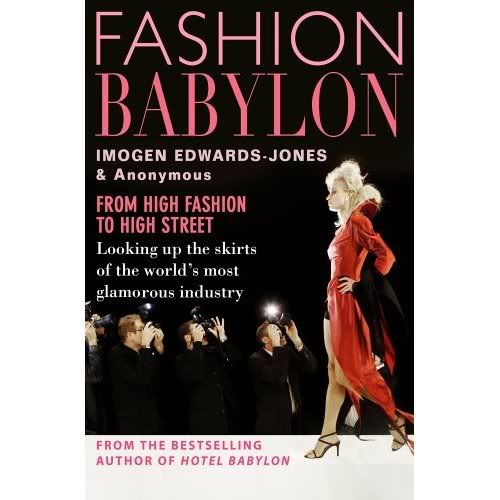
For some unknown reason, ‘Fashion Babylon’ landed at my office on my desk with no reply address, no covering letter, nada. I had heard of the author who wrote this book, Imogen Edwards Jones because her last book Hotel Babylon did rather well here though I never read it. From the blurb, you get immediately why I’m recommending this to you guys:
What is fashion? What is fashionable? Who decides what’s in and what’s out? Why is it green one year and blue the next? Why is one little black dress worth £3000 and another thirty quid? Is the catwalk really that catty? Is everyone high on drugs and full of champagne? What makes a supermodel so super? And a designer too hot to touch? Who is making the money? Who owns who? Who hates who? And who’s in each other’s pockets?
At first glance, you might think this is press junket sensationalism at it’s best and I too was very dubious. But I gave it a shot and read it in less than 3 hours. This book is co-written by Edwards-Jones and ‘annonymous’, being a ‘wide and varied collection of people who all work at the heart of the fashion industry.’ According to Edwards-Jones: "My top three sources are all very high profile and very much at the top of the fashion world. One of them still works at Vogue. And because I only finished the book in April this year, all the material is absolutely up to the minute".
This ‘novel’ is really fiction in disguise. It’s narrated by an annonymous and ficionalised designer and the basic story is about her struggle after a failed collection at London Fashion Week to make it to the top and show at New York Fashion Week, the following season and details all the trials and tribulations that go with this. Weaved into the loose story are anecdotes, tales, facts and figures that are ALL true with names changed to protect their identity. The process of how a collection is put together, how a catwalk show works, how designer price mark-ups work, along with anecdotal stories about designers and models who are for the most part, never named which is the most frustrating thing about this book – this stuff may all be true but who is guilty?? In short, this is the kind of book about fashion that doesn’t come around that often simply because a lot of things in the fashion industry are shrouded in mystery. It’s the sort of stuff we all want to know about fashion which is why I consumed this book in such a short amount of time.
Let me just give you some tidbits that illustrate the sort of stuff this book dishes up.
On how shops mark up designer clothing and why most designers dream of having their own store:
Shops mark designer clothes up by multiplying by 2.9, so a skirt that we sell to the shop for £100 is sold by the shop for £290. The shop, therefore, makes more money on a garment than the designer. The skirt costs me £30 to produce, so if I sell it in my own shop for £290 then I am making £260 profit (minus overheads), as opposed to the £70 I make when I sell to another store.
On the twenty-year rule in catwalk trends:
Fashion famously works in cycles; what goes in must come out, and vice versa. And this process usually takes about twenty years. So, if you are ever stuck for what to do for your next collection, just dig out a Vogue from twenty years ago and you won’t be far off. Hence, everyone these days is doing fitted and tight and pinched at the waist. Think Robert Palmer videos.
On why big designers don’t do large sizes:
Firstly, it comes down to cost. Simply in material terms, it costs me twice as much to make a size 16 as it does to make the same garment in a size 8….Secondly there just isn’t the demand for big designer clothes. Maybe it is a viscious circl: we don’t make them large, therefore large girls feel too fat for fashion and aren’t even tempted to go designer shopping. But all I know is that at the end of the season I am left with more 14’s than any other size.
On fashion ‘cabbage’ – stuff made out of over-ordered material in a factory:
Cabbage is the stuff that falls off the back of a lorry, or indeed out of the factory gate, and ends up on a market stall. It comes from the leftover product that the factory hasn’t used in the making of the bag/dress/shirt. It disappears out the back of the factory and ends up in a Florence or Milan market. The Gucci handbags in Florence market look just like the real ones simply because they are the real ones. We are a small company and can’t really afford cabbage.
On the 20th Century Vintage Fashion (this is in reality a FANTASTIC place!) , a farm in Dartmoor owned by Mark and Cleo Butterfield that specialises in vintage clothing:
There’s one designer, for example, who buys from him, gets ‘inspired’ by the clothes, and then burns them so that no-one can tell quite how ‘inspired’ he was.
On the kind of work that models REALLY want to do:
We pretend that we want to do Vogue, Vogue Italia, Pop and all that shit, but what us girls really love is a catalogue. Freeman’s, Saks Fifth Avenue, that sort of thing. Or a perfume or jewellery ad. Less trendy, the better. The older and more prestigious the brand the less they change their advert. So you don’t want something too cool. The tackier the jewellery house, the more they pay.
On a Kate Moss anecdote:
Did you hear about that story about some young girls bumping into her (Kate Moss) on Oxford Street and asking her what it’s like to be a style icon? She was sweet about it, signed some autographs, and asked them if they liked fashion. They said yes, and she took them into H&M and bought them all some clothes.
Now you see why I was shamefully engrossed in this book for three solid hours. Obviously there is no way of proving these stories and ‘facts’ are true without someone bringing up a lawsuit against the author for defamation of character or something which as yet, has not occurred. Perhaps, the lid has been lifted off and for the most part, it does all makes sense. The one warning I would give is if you are like me, very deluded and like to think of the fashion world as a magical pretty place, then this book may just disillusion you and make you hate fashion for it’s cut-throat, dark side. I’m not saying it’s right but as a fashion outsider, it is grossly fascinating to read about this side of fashion that nobody likes to talk about but secretly, everyone wants to know.
gosh, i love your site. i loved that little kate moss anecdote. 🙂
i think i’ll buy that book!
thanks for all your entries, they’re awesome!
THANX!…i read about it…but ur entry about the book was the best!… very helpfull…thanx girl…keep it up!
the book seems really intersting..gonna try find it =)thanks for posting it up
… I don’t get the Kate Moss anecdote … unless it’s just saying that they have bad taste in fashion? Ummm….
I think it’s more like saying Kate was kind enough to take time out with her fans and take them shopping.
^I took it as Kate indirectly teaching the girls that beyond pricey designers, stores like H&M are also great locales for them.
Thanks for the tidbits Susie! I’ve been dying to get this book 😉
i think i’m gonna get the book too-it sounds interesting
I bought it and read it, loved it!!
Im at page 256 of 330!
Why should it end?
It’s definitely worth reading, you learn so much and you will be amazed at how many short cuts some designers make and that style is’nt the only competitive aspect in the fashion industry.
does anyone have any idea abt who ” anonymous ” might be ? .. i ‘ve been Looking for it for dayss ..
The ‘anonymous’ isn’t anyone in particular. The actual character is fictional but all the incidents in the book are real.
I’m currently reading the book, and LOVE it! Does anyone know any similar book? I would love to read more of this!!!
I absolutely loved this book…
I was home sick one day and read 10 chapters of it – I just couldn’t put it down…
I was left wanting more at the end of it – would be fantastic if the Author bought out a second part to it!!
Definitely recommend it be read by anyone interested in fashion.
Fashion is such a tricky industry to predict, because what is here today is gone tomorrow. Regardless, it’s fun to guess what’s going to be “in” for the various season.
this is a top book i have read it like 10 times! id recomend it to any fashionista’s out there!
I Am Reading This Book At The Min ++ It Is Fab, Getting All The Goss 😉
After Looking Through Net-A-Porters Website And Read All About The Designers Me And My Friend (Who Had Also Read The Book) Have Agreed That The Name Of The Company In Which This Disigner Makes Clothes For Is “Preen”, Check Them Out And Tell Me If You Agree 🙂
Thanks x
the kate thing is about kate designing for topshop but yet goes shopping at h&m
I’m reading this book at the moment, and I cant put it down it’s contagious, love the rawness of the drugs and the annorexia and the bitches! And the poor souls noses too…
Love it